The Story of Copper: Part 1
The Story of Copper: Part 1
As with other metals we have discussed previously in the forum of “How it Works,” the overwhelming energy of a galactic supernova explosion is responsible for releasing most of the universe's copper into interstellar space where it finds its place on planets like the Earth. On Earth, copper is deposited in ores that are primarily sulfides, alongside significant oxide and carbonate ores.
Some interesting facts about coppers lineage are:
- Copper was the first metal to be used by humans in 8,000 BC
- Copper was the first metal to be smelted from its ore in 5,000 BC
- It was the first metal to be cast into a shape in a mold in 4,000 BC
About nine-tenths of the world's reserves of copper are concentrated in just a few key areas, with Chile being the largest producer. Significant deposits are found in:
- The Andes regions of Chile and Peru
- The Great Basin of the western United States (Arizona, Utah, New Mexico)
- Canada
- Zambia and the Democratic Republic of the Congo
Overall, the total amount of copper on Earth is very large, but only a small fraction is economically viable to extract with current technology. Copper is mined primarily through large-scale open-pit mining, where rock is blasted, crushed, and transported for processing. For deeper deposits, underground mining is used. The ore is then crushed and ground into sand, followed by froth flotation to separate copper minerals from waste, creating a concentrate that is further refined into pure copper.
Copper is one of the few materials that retains its chemical and physical properties through repeated recycling, making it an ideal candidate for resource conservation. Recycling has thus become a major source, supplying about one-third of global demand. In 2023, it was estimated that 32% of global copper consumption came from recycled sources.
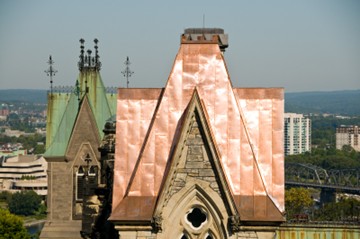
Copper is commonly referred to as the Red Metal and a classic example of its use is as roof material for Canada’s Parliamentary precinct as shown in Figure 1.
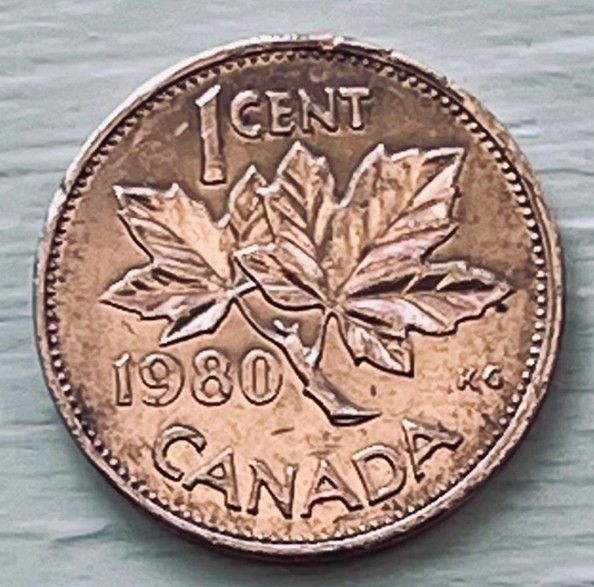
Another example of everyday copper was the now defunct Canadian penny depicted in Figure 2. Pre-1997, pennies were mostly copper containing (up to 98%). It is this fact that led to the expression “Copper Up” when looking through your pockets for some change in order to purchase something.
Copper is refined in Canada, primarily at a refinery in Montreal, Quebec, which processes concentrates and scrap into high-purity copper and precious metals. There are also limited refining operations in Ontario and Newfoundland and Labrador, with ongoing discussions about developing more midstream processing capacity elsewhere in Canada.
Key Canadian facts:
- In 2024, Canadian mines produced 514,582 tonnes of copper in concentrate. See Table 1.
- Canada’s exports of copper and copper-based products were valued at $10.7 billion in 2024.
- The green energy transition is expected to significantly increase copper demand, driven by its essential role in electricity networks and clean energy technologies, including, of course, electric vehicles.
|
Ranking |
Province |
Thousand Tonnes |
%age |
|
1 |
British Columbia |
249 |
48.3 |
|
2 |
Quebec |
23 |
4.5 |
|
3 |
Newfoundland and Labrador |
13 |
2.5 |
|
Other |
|
230 |
44.7 |
|
Totals |
|
515 |
100 |
Table 1: Canadian mine production of copper by province & territory as of 2024
In note 3 above, we point to copper’s electrical conductivity, which is a significant property and one which is now evident in almost every daily news cycle. It stretches the imagination to think of the source of copper being explosions in the massive, ever-expanding universe that presents itself when we look at the night sky. However, to understand the flow of electricity, we have to stretch our imaginations even further from the massive awe-inspiring universe, right down to the very, very small microscopic level. We need to imagine the level of the atom and its electrons
Electrical current is readily conducted in metals because electrons are in a free state. In essence, atoms are in intimate contact and can share electrons with some of these electrons existing unattached to any atom, that is they are free. There are a very large number of free electrons in copper, a 1 mm cube of copper contains about 1020 free electrons. Try to imagine that if you can: from the majesty of the observable universe to the microscopic detail of 10 to the power of 20 free electrons in one square millimeter of copper.
The free electrons are available to move instantly and produce current flow in response to the application of even the smallest electrical potential (voltage) applied between end points of a conductor. Electrons in a copper wire, like that shown in the left in Figure 3, can be like water in a pipe; when water enters one end of a full pipe, water immediately comes out at the other end.
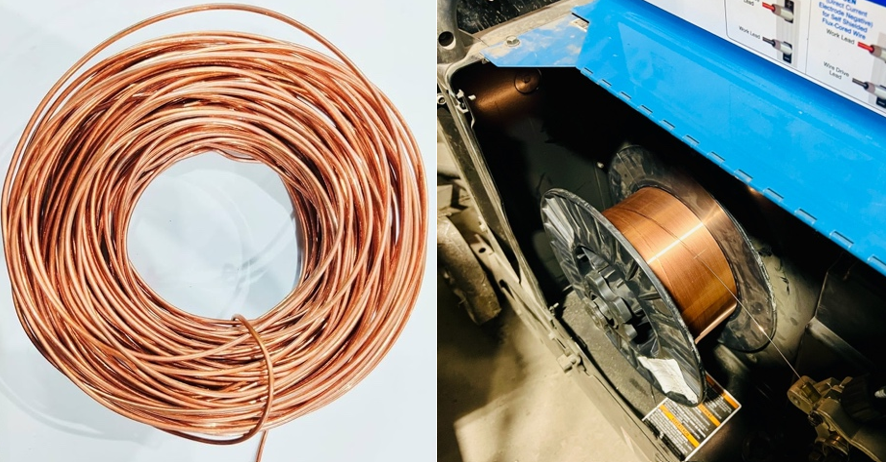
The GMAW wire shown in the spool in Figure 3 (right) is flashed with copper in order to enhance the electrical conductivity, allowing for better current transfer from the contact tip to the wire. Contact tips in a GMAW/FCAW gun are primarily made of copper, chosen for the excellent electrical conductivity and heat resistance. For increased durability, they are often manufactured from alloys like copper-chrome-zirconium
 The excellent electrical conductivity of copper therefore makes it indispensable for:
- Electrification of industrial sectors and transportation (including EVs and charging infrastructure)
- Deployment and modernization of national energy grids and renewable energy systems (wind turbines, solar farms)
- Vital equipment for agricultural mechanization, irrigation control, and smart farming applications
- Manufacturing advanced defence and communication systems
Moving on from the electrical properties to those other properties that copper imparts to metals. Copper is a key ingredient in alloys such as brass and bronze and can be recycled indefinitely without losing quality, making it vital for a sustainable, low-carbon economy.
As such, copper is used to produce several alloys, many of which are weldable and it helps to:
- Add strength & hardness: Alloying with elements like tin (bronze), zinc (brass) to increase strength and wear resistance, making them suitable for demanding parts like gears and bearings.
- Add corrosion resistance: Improves resistance to rust and degradation, crucial for plumbing, marine, and outdoor applications. For example, Aluminum Bronze and Monel
- Produce aesthetics: Adds colour variations, from golden brass to silvery finishes, used in decorative and architectural elements.
Moving along, we will explore these alloys and our ability to join them in the upcoming second part to this series, the Story of Copper Part 2.
Mick J Pates IWE
President, PPC and A
-----
Disclaimer
The information provided is intended for general interest, to educate and inform our audience. The CWB and those providing feedback to the questions do not take any responsibility for any omissions or misstatements that could lead to incorrect applications or possible solutions that industry may be facing.
How It Works content is submitted by Industry experts to the CWB Association and does not necessarily reflect the views of the CWB Group. When testing for CWB Certification or CWB Education, please refer to CWB Education textbooks or CSA standards as the official source of information.