Quenched and Tempered Structural Steels
Quenched and Tempered Structural Steels
In our earlier discussions on steel in the “how it works” forum, we had mentioned heat treatment and how the metallurgical nature of steel allowed heat treatment to shape properties.
There were two types of heat treatment that we covered, namely:
-
Post Weld Stress Relief......Where there is no change in microstructure, only a relief of locked in stresses from fabrication.
-
Normalizing......Where there is a complete change in microstructure. The microstructure of the steel is effectively remade.
However, we did not cover quench and tempering treatments that can produce high strength steels such as CSA G 40.21 700QT (100QT). This is a high-strength, quenched and tempered structural steel grade defined by CSA under the Canadian standard for structural quality steel, G 40.21. The specified minimum yield strength is 700 Mpa or 100 Ksi.
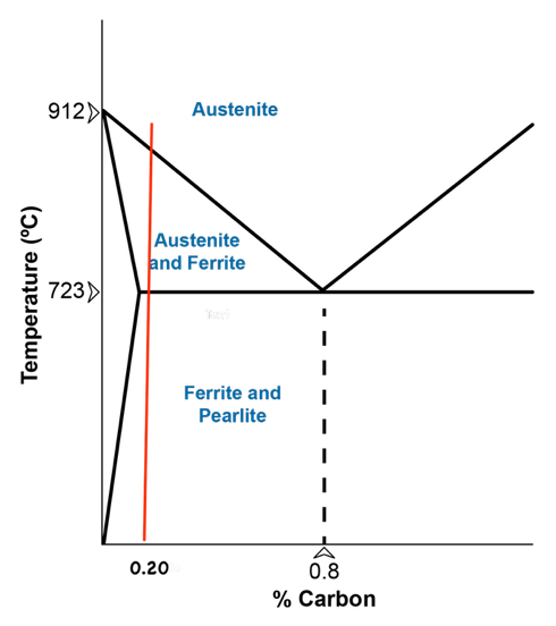
Quenching and tempering is a two-stage heat treatment process used to maximize the strength, hardness, and toughness of a steel. Initially the steel is heated above its critical temperature into the austenite range, as illustrated in the low carbon end of the basic iron/carbon diagram in Figure 1.
The sequence of quenching and tempering is listed below:
Heating into the Austenitic Range
- Heat the steel into the austenitic range. In the order of 875C for a 0.20% carbon steel, as shown by the red vertical line in Figure 1, and hold at temperature for a minimum soaking time.
Quenching to increase hardness and strength
- The steel is then cooled very quickly by using a quenching medium such as water, oil, or forced gas/air. The quenching medium will depend on the steel type.
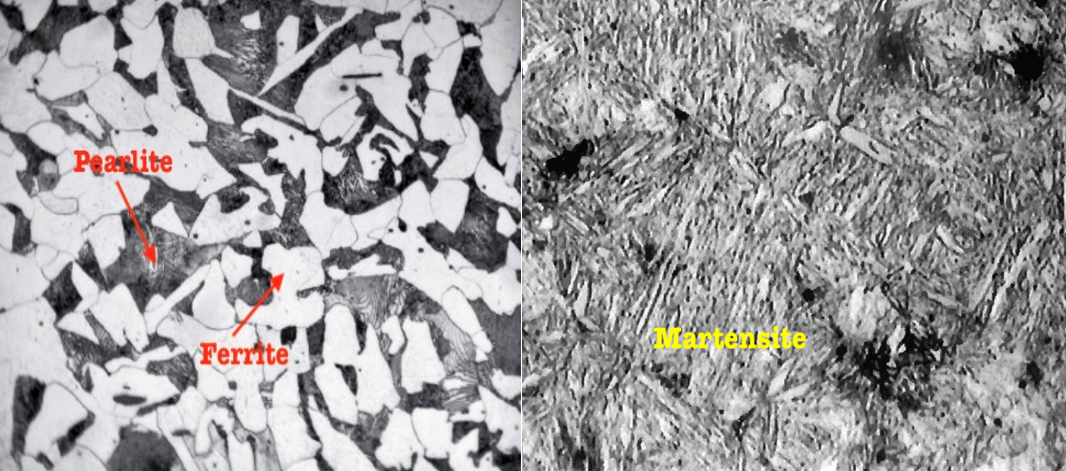
- This rapid cooling prevents the steel from going back to its original microstructural state of ferrite and pearlite which depends on slow cooling over time. The carbon atoms get trapped in another state and create a microstructure known as martensite. The martensite makes the steel extremely hard and wear-resistant, but also prone to cracking. Different typical microstructures are shown in Figure 2
Tempering to restore toughness and some ductility
- The quenched steel is reheated to a controlled temperature for a specified period of time. For structural steels such as CSA 700QT this would be around 600 deg C and the result is an increase in toughness and ductility after the steel is cooled in air
Since these Q and T steels get their properties from heat treatment, then it must be imagined that the application of heat by welding will have to be controlled in order to protect those properties.
The weld procedure must carefully limit heat input, within that given in the procedure, and control the maximum interpass temperature which is critical to maintaining the parent metal properties. The mechanical properties from the Q&T process, strength and toughness, are much more likely to be lost these if those values are excessive. The heat-affected zone (HAZ) can undergo localized softening, grain growth, and potential embrittlement so welding control is very important.
In addition, the hard martensitic microstructure, leads to an increased susceptibility to HICC (Hydrogen Induced Cold Cracking) in the weld zone, especially, as the material thickness increases.
The following guidelines are extracted, in part, from CSA W 59, “Welded Steel Construction”
- ”For welding of quenched and tempered steels, the steel manufacturer’s recommendations stating the maximum permissible heat input, preheat, and interpass temperature necessary to achieve proper welding shall be taken into account. Such considerations shall include the additional heat input produced in simultaneous welding on the two sides of a common member or the use of multiple electrodes. Note: An example of this would be the fabrication of a three-plate T-beam with both sides of the web/flange attachment being welded at the same time.
- Electrodes of any classification used for welding quenched and tempered steels shall have been shown to have given a diffusible hydrogen content not to exceed H4. Alternative hydrogen levels may be used depending on restraint, steel composition, and welding heat input as outlined in Annex P of CSA W 59“
For the 700 QT under CSA W59 or grade 100 under AWS D1.1, it is recommended that matching strength electrodes are used. For example, for the SMAW process, this would be the E76XX-X for CSA and E110XX as the AWS equivalent.
It can be seen from our discussion that the welding of these Q and T steels must be highly controlled and the “welding practitioner” must focus on following the welding procedure, as described, in order to maintain the desired weldment properties upon completion of welding.
Finally, the Electrogas and Electroslag are not suitable for welding these steels, due to the very high heat input of these processes.
Mick J. Pates IWE
President, PPC and Associates
***
Disclaimer
The information provided is intended for general interest, to educate and inform our audience. The CWB and those providing feedback to the questions do not take any responsibility for any omissions or misstatements that could lead to incorrect applications or possible solutions that industry may be facing.
How It Works content is submitted by Industry experts to the CWB Association and does not necessarily reflect the views of the CWB Group. When testing for CWB Certification or CWB Education, please refer to CWB Education textbooks or CSA standards as the official source of information.