The Story of Molybdenum
The Story of Molybdenum
As with other metals we have covered in “How It Works,” we can conclude that Molybdenum was created in the stars. It is a heavy element synthesized through complex stellar processes and is subsequently dispersed into the cosmos, and therefore our Earth, by interstellar explosions.
Molybdenum does not occur naturally as a free metal on Earth as it is found only in its oxidised state. It is a silvery metal, possessed with the sixth-highest melting point of any element found on the planet.
Canada has significant molybdenum resources, primarily located in British Columbia. As a major critical mineral, it is mined both as a primary product and as a by-product of copper mining. Major projects include the Endako Mine and various developments like the Davidson deposit. There are several other high-grade proposed projects in BC and others in New Brunswick, and Newfoundland and Labrador. The Wildcat Project in New Brunswick is a rare, high-grade critical minerals prospect focused primarily on molybdenum and associated other mineral deposits while the Soissons project, also in New Brunswick is being developed for both tungsten and molybdenum.
From our perspective, in the fabrication of metal alloys, the key properties of Molybdenum are its ability to increase both strength and corrosion resistance in steels. In addition to this, the element plays a vital role in imparting hot strength to high temperature engineered materials.
As said, about 80% of the worlds Molybdenum is used in the alloying of specific engineered steels. Significant properties of the metal with regard to steels can be defined as:
- Increases strength and hardness: Molybdenum enhances the hardness and strength of steel. It is one of the most effective elements for increasing the hardenability of steel.
- Improves toughness: In certain steel types, molybdenum improves toughness, i.e. the ability of the material to absorb energy and deform without fracturing.
- Enhances corrosion resistance: When added to stainless steels, molybdenum significantly boosts their resistance to corrosion and pitting, especially in chloride-rich and acidic environments. This is why molybdenum-containing stainless steels are critical for chemical processing plants and marine applications.
- Increases high-temperature strength: Molybdenum is a refractory metal with the sixth-highest melting point of any element. This property makes it invaluable for creating high-temperature alloys used in critical applications like jet engines and other equipment operating at high temperatures. In this respect Molybdenum enhances a metal's resistance to "creep," which is the tendency of a solid material to move slowly or deform permanently under the influence of persistent mechanical stress at high temperature.
Let us take a look at three examples of why we would use a particular type of steel to take advantage of its molybdenum bearing properties.
Austenitic Stainless Steel
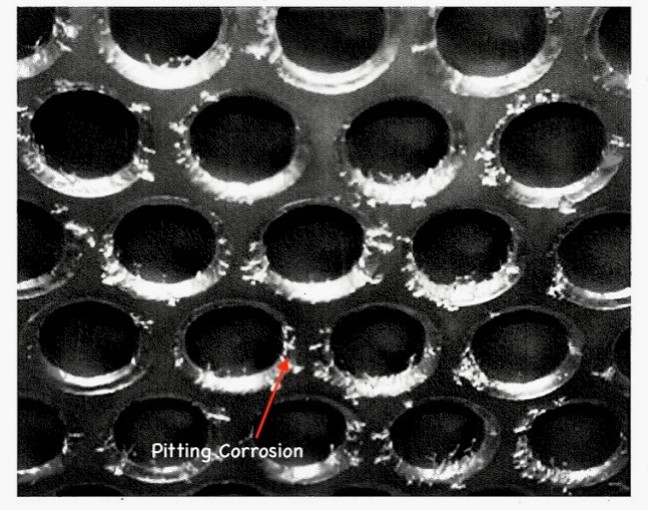
Austenitic 304L vs 316L stainless steel. We would select 316L instead of 304L primarily for its superior corrosion resistance in harsh environments. The 316L contains 2-3% molybdenum, which dramatically improves resistance to pitting, and crevice corrosion caused by certain specific environments. An example of pitting corrosion is shown in Figure 1.
The welding of 316L is relatively straight forward using matching welding consumables in the majority of situations.
Martensitic Stainless Steel
410NiMo is a martensitic stainless-steel alloy optimized with nickel and molybdenum for superior strength, toughness, and resistance to hydro-cavitation, stress corrosion cracking, and wear. It is primarily utilized in highly stressed, corrosive industrial environments, most notably in hydroelectric power generation to resist cavitation, as shown in Figure 2, and in the offshore oil /gas, and petrochemical sectors.
The main challenge welding martensitic stainless steels is the avoidance of cracking as the result of the high hardness of martensite in the heat affected zone and weld metal. This cracking probability will be assisted by the presence of hydrogen. An “in depth” welding procedure must control sources of hydrogen such as moisture, dirt, grease and other contaminants, and an adequate preheat must be applied and maintained. In most case a post weld tempering or annealing should be carried out immediately without letting the part cool down. Again the “in weld” and “post weld” sequence of heating should be guided by the weld procedure.
Chrome Moly Vanadium Creep Resistant Steels.
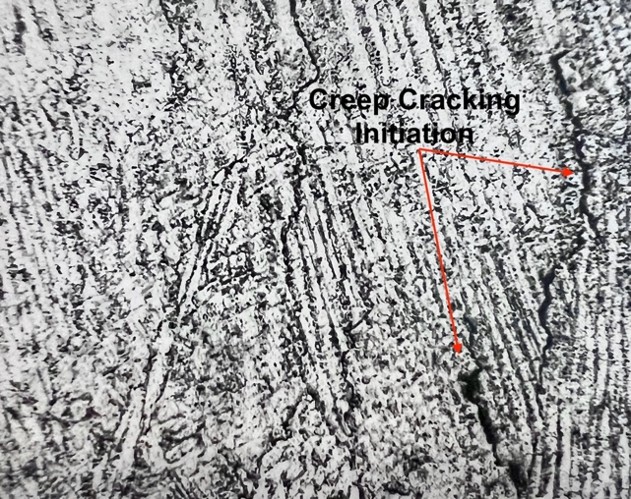
These steels usually contain 0.5 to 1 % Mo for enhanced creep strength. They are widely used for pressure vessels and piping in the oil and gas industries and in fossil fuel and nuclear power plants for their hot strength and resistance to creep cracking. An example of creep cracking is shown in Figure 3.
Hydrogen Induced Cold Cracking (HICC) can be a factor during welding of these steels and low hydrogen welding processes and/or consumables are therefore essential. Preheat is also necessary for most of these alloys and many codes and specifications will contain guidelines for preheat levels. Most of the creep resistant steels require PWHT usually made mandatory in the applicable fabrication code.
Welding consumables matching the parent metal composition are readily available for most of these steels and for the usable welding processes.
Again, the importance of a comprehensive welding procedure cannot be over-emphasised. Such a procedure should be followed to the letter for both these martensitic and high temperature molybdenum containing steel examples described above.
Mick J Pates IWE
President PPC and Associates
***
Disclaimer
The information provided is intended for general interest, to educate and inform our audience. The CWB and those providing feedback to the questions do not take any responsibility for any omissions or misstatements that could lead to incorrect applications or possible solutions that industry may be facing.
How It Works content is submitted by Industry experts to the CWB Association and does not necessarily reflect the views of the CWB Group. When testing for CWB Certification or CWB Education, please refer to CWB Education textbooks or CSA standards as the official source of information.